
Step 01 — Credential audit
The audit is a list, and it is almost always longer than the property expects. Every format currently issued: room cards, spare cards, pool bands, day-visitor credentials, staff badges, contractor passes, the drawer of old cards nobody has thrown away. For each one: what reads it, who receives it, which zone it controls, and who ordered it last.
The reason to start here rather than with a product is that most properties are running more credential types than they think, several of which nobody owns. Duplicated formats, two numbering conventions and a population being issued something that made sense four years ago are the normal findings, not the exceptional ones.
What the audit produces:
- A list of every credential format in circulation, with an owner for each
- The populations receiving them, including the ones nobody had counted
- Formats that duplicate each other and can be consolidated
- Credentials in circulation that should have been retired
Step 02 — Technical confirmation
This is the step that decides whether a project is straightforward or difficult, and it is the one properties most often want to skip. What is installed, what credential type it is configured to accept, who currently encodes credentials, and whether new credentials must join an existing numbering range.
The fastest route to an answer is a working credential — one that already opens doors. It carries the technology and often the numbering convention physically. The second-fastest is what the property’s own system reports when it reads one. A product nickname from a previous order is not evidence, and we will not treat it as such.
Installed systems differ by site, by configuration and by age. A credential that works at one property with the same lock brand can fail at another. Compatibility is confirmed against the property’s lock system, credential technology and encoding requirements before production. We do not claim universal compatibility.
Step 03 — Construction shortlist
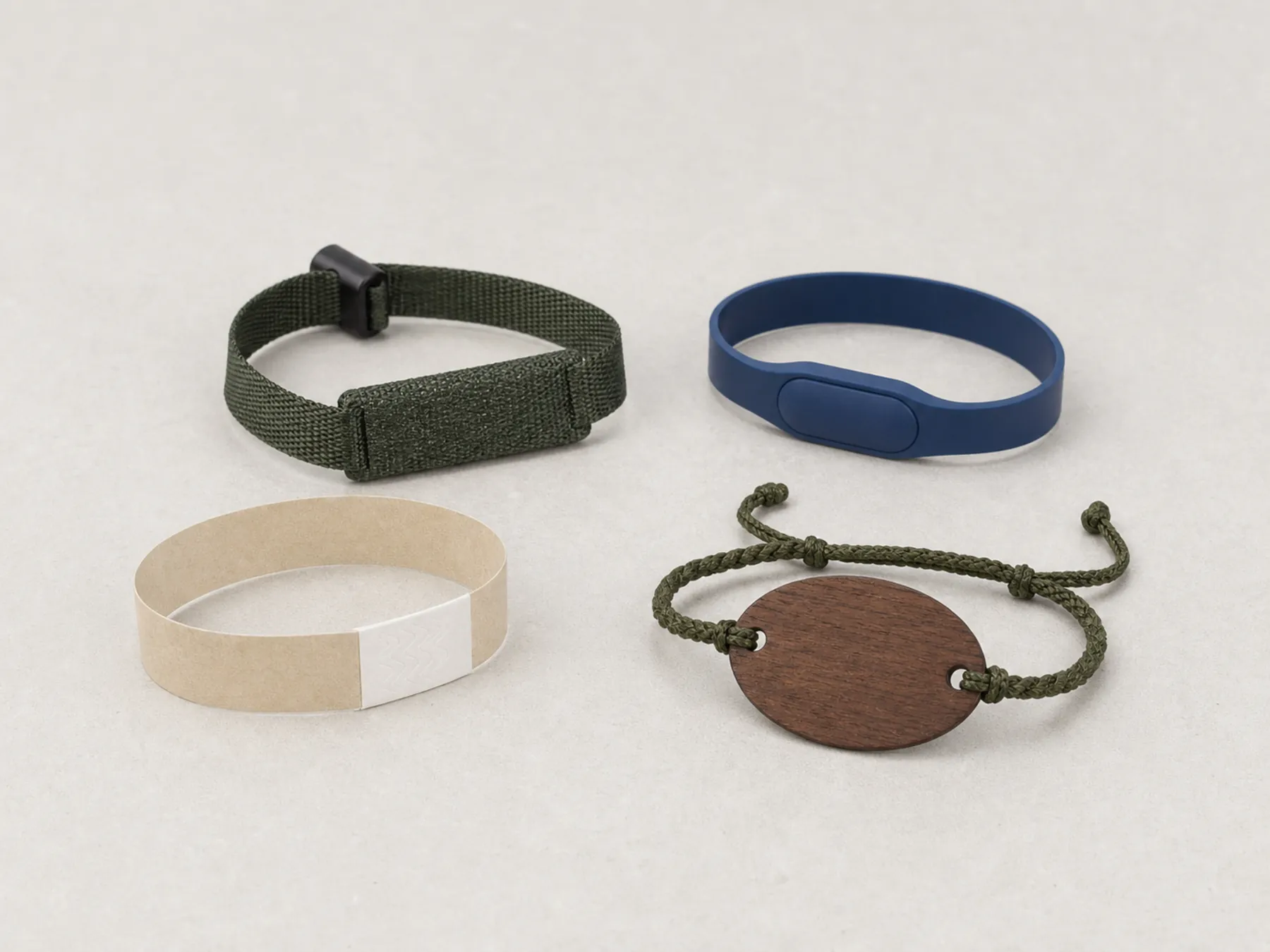
With the technical question settled, the physical one becomes tractable. Wear period, water exposure, who is wearing it, whether it is recovered, and whether transfer has to be controlled — those five inputs narrow thirty-one catalogue models to two or three worth sampling.
This is also where we say no. A wood face for a water park, a fabric band for daily immersion, a one-way closure for a property that intends to recover and reuse: each of those is a specification that will fail, and it is cheaper to rule it out now than to prove it with 2,000 pieces.
The five inputs that produce a shortlist:
- Wear period — a day, a stay, a season, a year
- Environment — dry, splash, continuous immersion, salt, heat cycling
- Population — adults, children, staff, day visitors
- Lifecycle — recovered and reissued, or issued once
- Transfer risk — whether the credential must not be passed on

Step 04 — Artwork system
One hierarchy across every population, rather than a design per credential. The resident band, the child’s loop, the day credential, the staff band and the card should read as one family, differentiated by colour and by simplification rather than by separate designs.
That is an aesthetic decision with a commercial consequence: minimum order is 500 pieces per artwork, so every additional design is another count. Artwork restraint is the single most effective way to control the size of an order, and it usually produces a better-looking result as well.
Different substrates resolve detail differently. A card and an engraved wood face carry a full mark; a woven strap and a narrow band carry a simplified device. Forcing an identical treatment onto all four makes the weakest look like an error.
Step 05 — Sample approval
Approval happens on a production-realistic sample, at the property, against the property’s own readers. Not on a flat proof, not on a photograph, and not at our desk.
What the sample settles: how the artwork sits on a curved and moving surface, whether the closure is operable by staff in a hurry and by a guest with wet hands, whether the profile is comfortable for the actual wear period, and whether the credential reads at the awkward readers rather than the convenient ones.
Write the acceptance criteria down before the sample arrives. Without them, a sample review becomes a conversation about impressions, and there is nothing to hold a later run against.
Recessed door units, readers mounted on or near metal, outdoor readers in bright sun, locker banks used with wet hands. A credential that satisfies those satisfies the desk; the reverse is not true.
Step 06 — Controlled supply and reorder
Goods are supplied in counted, range-labelled blocks so a property can record what arrived without opening everything. That is decided at order time and cannot be retrofitted, and it is what makes a credential estate auditable a year later.
The approved sample, artwork revision, colour reference, confirmed credential input and packing instruction are held together as one reorder reference. A repeat order is checked against that reference rather than against a memory of the last one, and any changed field triggers a fresh check rather than a repeat.
Production is 14–21 days after artwork approval. The clock starts at approval, not at enquiry, which is why the artwork step is where schedules are won or lost.
What sits outside this scope
Lock hardware, access-control software, property management systems and payment integration are not part of this work unless a written scope says otherwise. We specify and supply the physical credential against a confirmed environment.
That boundary is deliberate. A supplier who claims the whole system is a supplier who will be blamed for the parts they do not control, and a property is better served by someone who is precise about where their responsibility begins and ends.